Ears to the Ground: Adventures in Field Recording and Electronic Music (Ben Murphy) Read 2025
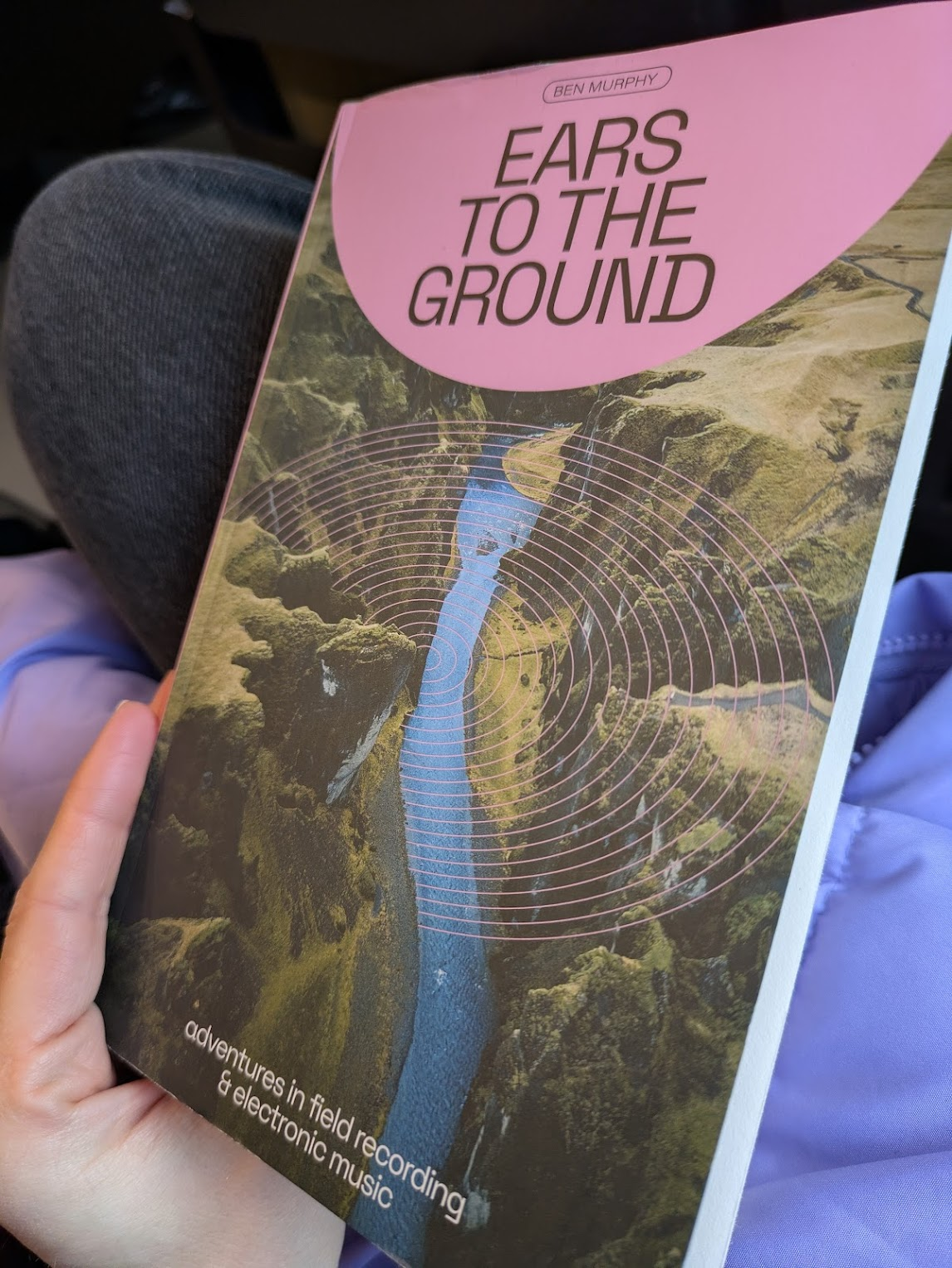
A collection of interviews and music journalist reviews and articles. It got me a ton of inspiration about how to think about field recordings, and what artists to listen to.
Here are a few: Field recording artists
Despite the ever-increasing popularity of field recordings in electronic music, he’s surprised their use isn’t more widespread. “I don’t feel it’s prevalent at all considering the revolution that it is. We can now make music out of literally anything we can record, so why pick up a synth or a guitar when you can use the sound of a pelican, a cross-channel ferry, a year of sounds from an orchard, sheep on their way to the market, an autopsy, jam jars, plastic washed up on beaches, Sunak’s helicopter, the floods in Libya, cells replicating, a skyscraper being built, a pig’s life, a horse’s skeleton?”
More pointed is One Pig, which used noises of the life cycle of a hog bred for its meat, inter- rogating our consumption of other animals through the medium of sound. Grunts and squeals are set against his abstract electronics on tracks such as “September”; “October” is a tranquil moment of ambi- ent beauty, but “November” uses disorienting sounds and glitches, alternately metallic and organic, to denote the pig’s experience in its enclosure, before the disturbing, chopping percussive sounds of “February” indicate the end of the animal’s short life.
‘As John Cage said, “Which is more musical, a truck passing by a factory or a truck passing by a music school?” I think most people would say that the sound of birdsong is an expression of harmony more than the Radio 1 playlist. Sound is just the movement of air, you’d be hard pressed to come up with a definition of music that didn’t end up sounding suspiciously the same as that. After all, acoustic music is just made with bits of wood hitting animal skins, or pushing air down tubes, or plucking stretched sheep guts over a bit of a tree. We’ve built a whole network of words to try and substantiate the idea that human instruments create sounds that have coherent, pleasing forms and most other forms of sound don’t, or that this particular noise is more harmonious than that noise, but these boundaries crumble really quickly when you actually start working with the material of sound itself.’
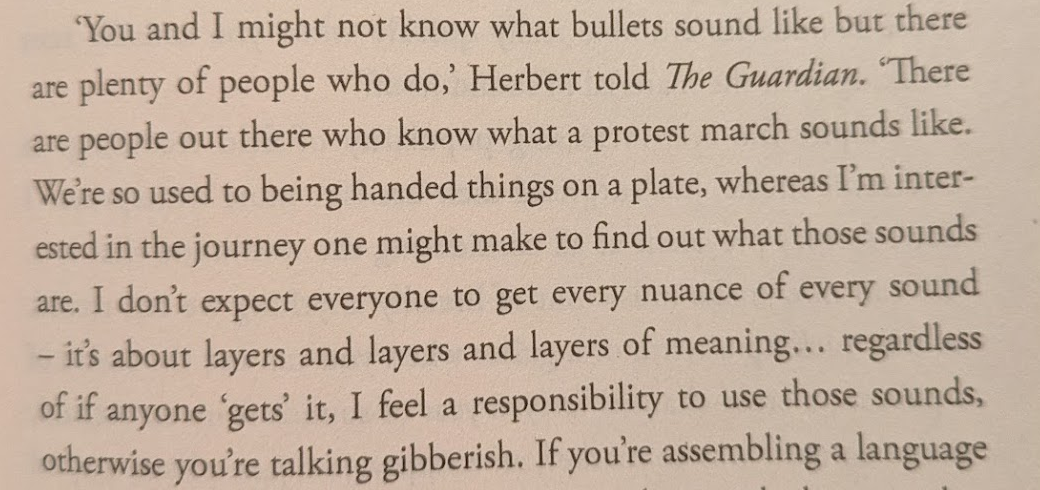
Every sound that Herbert selects or records to use in his compositions has some meaning, an additional layer. He’s mentioned before that he finds the lack of any message in music to be uncomfortable, just another contribution to the ‘everything is fine, carry on as normal’ status quo. His work often has a political dimension, and he sees that as especially pressing at a time when the climate emergency worsens with each day. Even on his 2015 album, The Shakes, which found him returning to soul-inflected house music, rich with organic instruments and guest vocals, there are the sounds of used bullets, protest marches and his grandfather’s piano - a person who was influential on the young Herbert, giving him an old copy of The Communist Manifesto.
‘I was convinced that if you could reproduce the acoustics of environments and the sounds of places you could perhaps think about recreating something of the history of the event, the spirit of place’, Watson told The Quietus. ‘People often say when they enter a house they can sense an atmosphere - it’s that intangible thing - and it’s the same with landscapes and habitats. It’s something the fauna responds to as well.
‘I think music that includes field recordings has a quality about it that draws you into the space of the song,’ she continues. ‘Some panoramic recordings taken in the landscape, wildlife recordings for example, really give you a sense of place. Microscopic recordings are interesting too, especially if they’re familiar to sounds you hear in your daily surroundings. I think they give a sense of the musician within the fabric of the music. Particularly within electronic music, I like the idea of capturing a snapshot of reality, I think it provides a deeper meaning to the sound.’
‘There was a reason we took those recordings in those particular places at that particular time, and that was because those sounds and experiences were a part of our own personal story. It was like having a photograph album of tiny sounds. Had we not taken those recordings, that moment in time may have been lost to failing memory or whatever, and they seem to take on a new significance having been captured. Listening back to the recordings, the memory of the experience is quite moving. I’m transported back to how I felt that day, what was going on in my life at the time.’
‘Every city that I’ve been to, there’s one thing that stands out sonically that I remember,’ he says. ‘When I travelled for shows back then, I used to make at least one field recording, not to use in a piece, but just as a journal. To have a sense of recall of Barcelona, I remember recording the ships at one of the harbours and trying to find one sonic thing that I found interesting. Each city sounds different. There’s so much information that can be learned from trying to understand city soundscapes, how people are living within these sounds.’